Chatfishing, explained
The conversation is going great. Every reply is witty, warm and perfectly punctuated, and they always seem to know exactly what to say. Then a small doubt creeps in: is this actually them, or is a chatbot doing the talking? That doubt has a name now: chatfishing.
AI is now part of how many people date. Scientific American, citing a 2025 Norton study, reported that six in ten dating app users believe they have run into at least one conversation written by AI. Using a tool to fix a typo or find a first line is one thing. Letting a chatbot carry the whole relationship is another. Here is how to spot the difference, sources checked as of 30 Oct 2026, and what to do if you suspect it.
What chatfishing is (and is not)
In Psychology Today, physician and writer Bruce Y. Lee describes chatfishing as using AI to guide what you say online in order to lure someone in deceptively. Unlike catfishing, the person and the photos may be real; it is the words that are not. That distinction matters. Someone who asks a tool to tidy up one message is not the same as someone who pastes your every reply into a chatbot and sends back whatever it writes.
- Catfishing: a fake identity, fake photos or a fake life story.
- Chatfishing: a real person, but AI-written messages presented as their own.
- Grey zone: occasional help with a first line, spelling or a language they are not fluent in.
Signs your match might be using AI
None of these signs proves anything on its own. Plenty of people write formally, take a while to reply or simply have good grammar. What matters is a pattern that keeps repeating, especially when the style does not match how the person talks elsewhere, like in voice notes or in person.
- Too polished: long, flawless paragraphs with no typos, slang or shortcuts, every single time.
- Generic warmth: replies that sound kind but could be sent to anyone, with no detail from what you said.
- Stiff or formal tone: phrases nobody uses when texting, or a structure that reads like an essay.
- Ignores shifts: you change topic or tone and the reply carries on as if nothing changed.
- Details that do not add up: hobbies, age or history that contradict what they said before.
- Odd timing: consistently long gaps before every reply, or instant long answers at strange hours.
- Voice versus text: in a voice note or call they sound like a completely different person.
Why people do it
Most people who lean on AI are not running a scam. They are nervous, short on time, writing in a second language or worried about saying the wrong thing. Experts quoted by Stylist note that using AI as a writing aid can make sense for people who lack confidence in writing. The problem starts when the tool replaces the person and the other side is building a connection with someone who is not really there.
- Texting anxiety or fear of sounding boring.
- Writing in a language that is not their first.
- Juggling many chats at once and wanting to keep them all going.
- In the worst case, deliberately hiding who they are, which is a red flag.
How to check without accusing anyone
Psychology Today recommends keeping the message-only phase short and moving to a phone or video call as soon as you can, and points out that meeting in person is the only reliable way to see who is behind the messages. You do not need to interrogate anyone. A few natural moves usually tell you more than a hundred texts.
I feel like I would enjoy this even more out loud. Quick call tonight or tomorrow?
Copy thisOkay, real question: what is the worst thing you have ever cooked for someone?
Copy this(Voice note) Telling you this one out loud because it does not work in writing...
Copy thisYour messages are so good I am half convinced you have a ghostwriter 😄
Copy thisBe honest, are you just using ChatGPT? Because this is obviously not you.
Better not send itWhen it is more than AI: stay safe
Sometimes AI-polished messages are part of a romance scam rather than just nerves. The classic warning signs do not change: they want to move off the app quickly, they can never meet, and sooner or later they ask for money, gift cards or crypto. The US Federal Trade Commission is clear: never send money or gifts to someone you have not met in person. Report the profile in the app and stop replying.
- Requests for money, gift cards, crypto or wire transfers, for any reason.
- Pressure to move to another messaging app straight away.
- Always a reason why a call or meeting cannot happen.
✓ Do this
- Look for a repeated pattern, not one perfect message
- Ask specific questions that need a personal answer
- Suggest a quick call early on
- Report profiles that ask for money
✕ Avoid this
- Accuse someone based on good grammar alone
- Stay in text-only mode for weeks
- Send money to someone you have not met
- Ignore a voice that does not match the texts
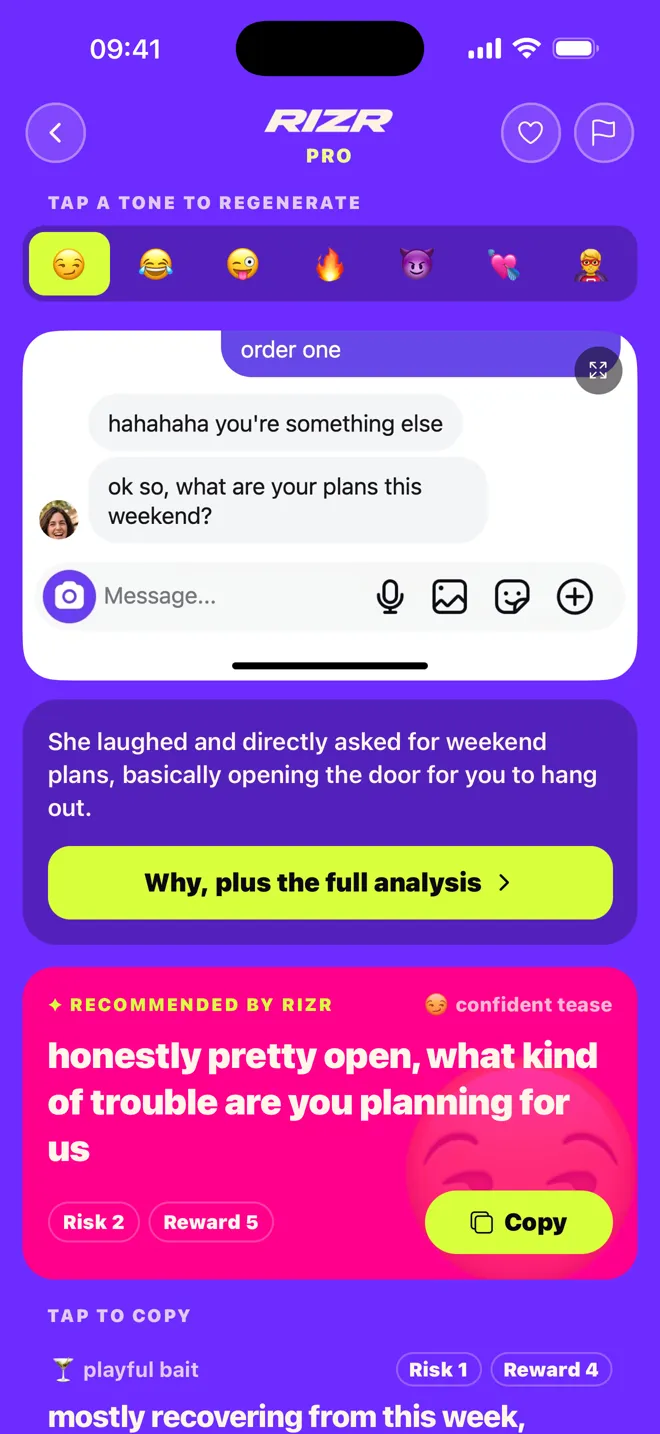
Want help replying without sounding like a robot? Upload a screenshot of the chat to RIZR and pick a tone. It suggests options you can edit so the message still sounds like you.
Try it freeQuick questions
What does chatfishing mean?
Can you really tell if a text was written by AI?
Is it wrong to use AI to help with dating messages?
What should I do if I think my match is chatfishing me?
Are AI-written messages a sign of a scam?
Keep reading
Updated October 31, 2026 · By the RIZR team